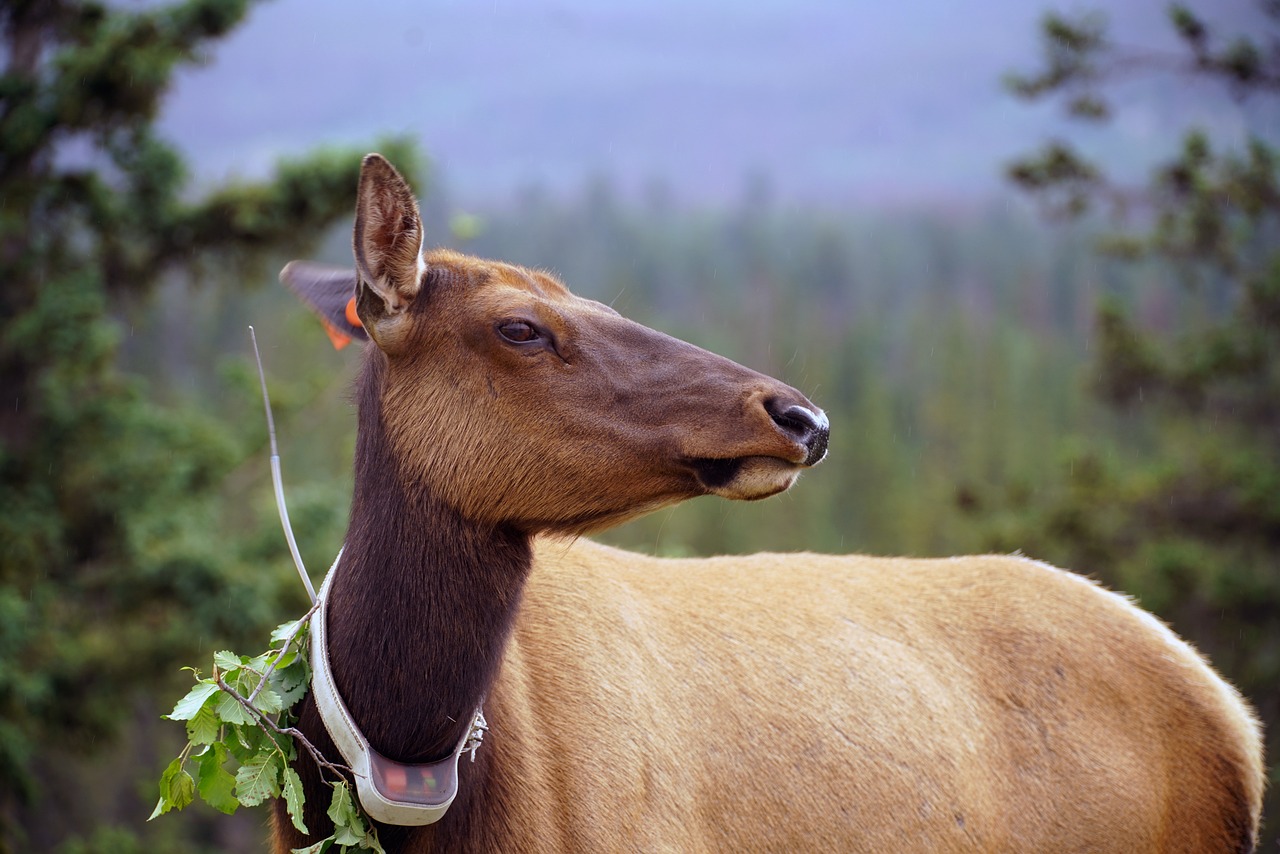
Elk with ear tag and radiocollar (Pixabay/gayleenfroese2)
Louise Hayward, PhD candidate, University of Exeter
I am part-way through collecting data for a project looking at ethics and welfare in wildlife marking and monitoring (leg rings, satellite trackers etc.). The use of ‘tagging’ in wildlife research is increasingly common and is seen by many to be essential for studying at risk species, particularly those which migrate across human borders. However, tagging may result in welfare consequences for individual animals. My aim is to focus attention on the individual, in a field where the primary purpose is protection of whole species.
My research is internet-based, using online surveys and virtual interviews, allowing me to gather expert opinion from a global pool of researchers. I am using an iterative process, allowing researchers to anonymously share and revisit their experiences and opinions. The first stage of the process involved a qualitative survey. I am now conducting semi-structured interviews with survey respondents, as well as others with an interest in the subject.
During a recent interview, my attention was drawn to a potential bias in my work if most or all of my participants are from the ‘Global North’. Even where they work with species from the ‘Global South’, they may be ‘parachuting in’ to tag the animals, and then leaving, to study the data from their northern computers. This has caused me to reflect on the causes and implications of such bias, and consider how best to tackle them, or at the very least acknowledge them.
The potential for geographical bias in academia has been demonstrated in the fields of ecology and climate science (Carbon Brief, 2021; Maas et al. 2021). Of 100 highly-cited climate papers, less than 1% of authors were from Africa, and almost three quarters were affiliated with institutions in Europe or North America (Tandon/Carbon Brief, October 2021). Maas et al. (2021) point out that the scientific establishment is missing important perspectives as a result of such publication bias. Some of the barriers faced by these academics are similar to those I am speculating on in this post.
Searching for a sample
For the survey stage of my project, I tried to minimise my own bias by adopting some rules to find potential participants (of course, I decided what those rules were!). From the researcher community, I used Web of Science to find those who had recently published relevant work. To widen the sample to practical conservationists and rescue-rehabilitators, I used a set of search terms, contacting organisations who appeared in the first two pages of a Google Search – it was never going to be possible to look through all the results that were returned.
Clearly, this approach brings its own biases. For example, in using Web of Science, I am limiting the pool to those who publish regularly, perhaps those with good use of English (who may be more likely to have papers accepted in English-speaking journals), and those with access to collaborators (increasing funding opportunities for work of a ‘publishable’ scale) (Blicharska et al., 2017). Using Google also introduces bias; only those organisations picked up by the algorithm will be displayed. Online visibility will be influenced by, among other things, access to equipment, connectivity in the local area, and funding to maintain a web domain.
While the surveys were anonymous, there was an option to include an email to opt-in to further stages of the project. From those (65 of the total sample) I have been able to determine that 59 are based in the ‘North’ (North America, Europe, Russia, Japan; I’ve also included Australia/New Zealand in this category as they are similarly resourced), and 6 are based in the ‘South’ (in this case, they came from South America or Africa).
How much does global representation matter?
Gathering responses from those in the Global North certainly does not diminish the experiences of those respondents. It would be valid to focus a study on those regions, with a view to effecting some specific change. Certainly, in terms of discussing people’s affective experiences when tagging animals, useful and interesting data can be collected at any scale. Even then, it is arguably better to seek the views of as wide a range of people as possible. This would necessarily require giving a voice to those in the Global South.
Were the research to lead to practical suggestions to improve animal welfare during monitoring, under-representing the Global South would become particularly problematic. There is no point in recommending a change to the way ethics committees (or equivalent) work if many of the areas where people are working don’t have ethics committees! Compiling an online set of training videos would only be of benefit to those with sufficient bandwidth to view them.
Cultural differences in attitudes to animals will also impact likely success if they are not taken into consideration from the outset. For example, Jacobs et al. (2022) explored wildlife value judgements in students studying a range of sciences across seven (mostly Northern) countries, finding some differences in attitudes relating to ‘domination’ and ‘mutualism’. Though it was not with the aim of exploring geographical differences, I have included a values measure as part of the survey (Schultz’s Environmental Values Scale, 2001), which may expose patterns of response common to particular groups. Including knowledge and ideas from around the world represents the best chance of coming up with realistic improvements for the people involved, and ultimately for the nonhuman animals.
I am reconciled that my initial approach to collect survey respondents was justified. However, I intend to seek some researchers and rehabilitators from the Global South who may wish to contribute to the interview stage (one of my interviewees has kindly provided the names of some wildlife rehabilitators in the South who may be willing to be interviewed). This is not without issues of course, because respondents will need access to an internet connection for an online meeting platform.
The next phase of my project will be to run a second survey with the original respondents, asking them to reflect on the group’s responses, as well as revisit their own. My chosen method is based on a Delphi Technique (Mukherjee et al., 2015), for which subsequent responses come from those already involved in earlier stages. However, I am now considering how I could widen access to the survey, beyond the original group. Another option will be to construct focus group(s) that are representative of the global community. I am also considering carrying out a comparative analysis of the regulations in place in different regions, though this approach on its own does not give a voice to the individual researchers in those areas.
My project is predicated on the use of ‘expert voice’ and the best chance of successful, practical outcomes, will depend on having diversity among those experts. Writing about a Global North bias in developing the UN 30-30 proposals (an aim to conserve 30% of the Earth by 2030), Banerjee (2021) writes that, ‘any effort to build a Global Biodiversity Framework must begin with sincere listening to all parties, and learning from that listening.’
There are no simple solutions to this multifaceted problem. I am glad of the opportunity to consider how I could adjust my approach to achieve a better balance.
Author Bio:
I am a postgraduate Anthrozoology student at the University of Exeter. As an undergraduate, I studied wildlife ecology and was exposed to the historic and contemporary techniques used to collect data. It became clear that identifying individuals by applying a visible marker or a remote monitor, was going to become the standard for much wildlife research in the future, though at the time (1990s) there was little discussion about the possible effects of these devices, either on the science or on animal welfare. I went on to complete an MSc. in animal behaviour and welfare, and then spent many years as a humane educator and teacher. I have returned to study at a time when the use of ‘tagging’ is burgeoning. I hope to combine my interests in wildlife and welfare to refocus attention on the individual.
References:
Banerjee, S. (2021). Bridge the North-South divide for a UN Biodiversity Framework that is more just (commentary), 23 September. https://news.mongabay.com/2021/09/bridge-the-north-south-divide-for-a-un-biodiversity-framework-that-is-more-just-commentary/.
Blicharska, M., Smithers, R.J., Kuchler, M., Agrawal, G.K., Gutiérrez, J.M., Hassanali, A., Huq, S., Koller, S.H., Marjit, S., Mshinda, H.M., Masjuki, H.H., Solomons, N.W., Van Staden, J., and Mikusiński, G. (2017). Steps to overcome the North–South divide in research relevant to climate change policy and practice. Nature Climate Change, 7: 21-27. https://doi.org/10.1038/nclimate3163.
Jacobs, M., Duboism S., Hosaka, T., Ladanović, V., Muslim, H.F.M., Miller, K.K., Numata, S., Ranaweerage, E., Straka, T.M., Weston, M.A., and Abidin, Z.A.Z. (2022). Exploring cultural differences in wildlife value orientations using student samples in seven nations. Biodiversity and Conservation, 31: 757–777. https://doi.org/10.1007/s10531-022-02361-5.
Maas, B., Pakeman, R.J., Godet, L., Smith, L., Devictor, V., and Primack, R. (2021). Women and Global South strikingly underrepresented among top-publishing ecologists. Conservation Letters, 14(4): e12797. https://doi.org/10.1111/conl.12797.
Mukherjee, N., Huge, J., Sutherland, W.J., McNeill, J., Van Opstal, M., Dahdouh-Guebas, F. and Koedam, N. (2015). The Delphi technique in ecology and biological conservation: applications and guidelines. Methods in Ecology and Evolution, 6(9): 1097-1109. https://doi.org/10.1111/2041-210X.12387.
Schultz, P.W. (2001). The structure of environmental concern: Concern for self, other people, and the biosphere. Journal of Environmental Psychology, 21(4): 327-339. https://doi.org/10.1006/jevp.2001.0227.
Tandon, A. (2021). Carbon Brief – Analysis: The lack of diversity in climate-science research. https://www.carbonbrief.org/analysis-the-lack-of-diversity-in-climate-science-research/.
 Anthrozoology as Symbiotic Ethics