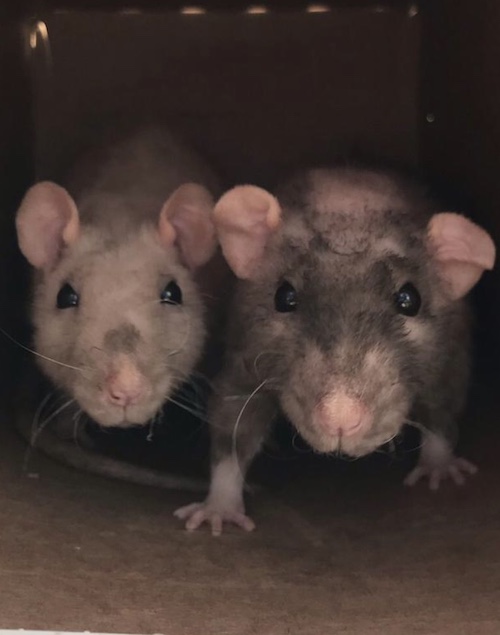
Otto (left) and Thomas, enjoying happier times together. Image by author.
Charlotte Heath, MA Anthrozoology student, University of Exeter
From the outset of my studies at the University of Exeter I had keenly anticipated my Anthrozoology Residential 2022 attendance. The weekend had finally arrived, although the theme of ‘living and dying with other animals’, had unfortunately turned out to be personally poignant. My beloved rat, Otto, had recently been diagnosed with an incurable illness, culminating in me juggling conference attendance with the responsibility of providing end-of-life care. However, through reflexive thinking (Salzman, 2002), I now see that despite these negative pressures, one talk, Animal love and grief: The role of understanding animals’ emotions in resisting human exceptionalism by Barbara J. King (2022a), particularly contributed to my individual experience, as well as several fundamental aims of the Exeter Anthrozoology as Symbiotic Ethics (EASE) working group (EASE, no date).
A principal aim of EASE is the endeavour to comprehend animal perspectives, not just those of humans (EASE, no date). I suggest that this sentiment is mirrored throughout King’s talk, which centres on her proposal that animals experience grief. King supports her argument through myriad case studies, each highlighting the behavioural and emotional reactions of specific animals following the death of a relative or companion. These vignettes, such as the account of the orca Tahlequah carrying her deceased infant for over two weeks (King, 2021a), provide detailed insights into the animals uniquely individual affective experiences. In using such attentive narratives, King arguably embraces a “passionate immersion” (van Dooren et al, 2016: 6), by providing “thick accounts of the distinctive experiential worlds, modes of being and biocultural attachments of other species” to achieve “immersive ways of knowing”.
Despite this, as King herself notes, such perspective taking can be condemned as anthropomorphism (Wynne, 2007). King, however, contests this potential charge by explaining that rather than necessitating anthropomorphic animal mind reading, grief responses can be outwardly observed by evaluating behaviour change. Akin to Qualitative Behaviour Assessment, this reading of an individual’s behaviour can render their subjective feelings and experiences accessible to others (Wemelsfelder et al, 2000). Moreover, King’s attempts to grapple with the animal viewpoint could alternatively be considered closer to “egomorphism” (Milton, 2005: 261) or “empathic anthropomorphism” (Davis, 2010: 267). By suggesting that animal grief is its own phenomenon, with intraspecies and interspecies variability (King, 2013b), King aims to understand through intersubjective empathy and experiential engagement. What results is a perception that animal grief is perhaps “like mine”, instead of the same as, or a projection of, the human grief experience.
King, therefore, advocates for personalised and nuanced attempts at understanding animal experiences, achievable through familiarity, appreciation of context, and investment of time. The understanding of animal minds remains incomplete (Carruthers, 2013). Although King cannot (Brown, 2015), and does not claim to (King, 2013a), exhaustively comprehend animal grief, her admirable efforts to empathise with animal others is surely exemplar in speaking to EASE’s goal of grasping animal perspectives.
King’s talk equally aligns itself with the EASE aim of improving animal lives through meaningful practical application, as well as those of human stakeholders (EASE, no date). Through her emotive narratives King aims to engage people, creating stories which give a face to her claims, reminiscent of van Dooren’s (2014) storied mourning. Through these stories King communicates the individual experience, which can draw “distant listeners into a sense of felt connection and so affective involvement” (van Dooren, 2014: 142) in the legitimacy of animal grief. By encouraging people to recognise that grief and love are not uniquely human, King, therefore, challenges human exceptionalism while evoking compassion.
However, as well as encouraging general empathetic concern for animal others, King (2022b) additionally calls for turning such compassion into real world action. For King (2021a) this encompasses all action that minimises harm to animal others, wherever possible. Whether through advocating for the importance of language in challenging human exceptionalism, endorsement of non-lethal conservation schemes, or arguing for animal-free medical research (King, 2021b), King inspires others in striving to practically improve animal lives. Therefore, although King’s work may not exemplify direct application based on specific research findings, it should be considered to have real world impact (Penfield, 2014). This residential talk is of course part of a wider King universe (King, 2022b); an entanglement of public talks, books, and media outreach, all contributing to a public engagement repertoire with arguably significant implications beyond academia (Poliakoff and Webb, 2007) for human-animal relations.
Furthermore, by encouraging compassionate action King is inherently responding to Haraway’s (2016: 1) call of “staying with the trouble”, of learning to live well with other species. Arguably King’s ethical advocacy, particularly her lively accounts of animal emotion, can be viewed as utilised tools, enabling her audience to become more present with animal others. As suggested by Desai and Smith (2018), such learning from, and facing the other, is vital in the development of caring about others as kin, or indeed “oddkin” (Haraway, 2016: 2). In this sense King’s talk is also enmeshed with another central value of EASE; to promote an empathetic and symbiotic approach to living alongside other animals (EASE, no date). This shared outlook is perhaps particularly apparent during King’s description of her conscious efforts to watch, learn about, and ultimately live more compassionately with the house spiders she once feared. For me, this exemplifies what Eason (2019: 5) describes as a “rich new alliance, an interspecies mutualistic coexistence” where “the alien ‘other’ animal … becomes a familiar one and no longer accentuates Cartesian distinctions between human and nonhuman animals”. Moreover, King does not negatively discriminate between animals but instead endorses the unique specialty of every species; not just companion animals but also those socially constructed as less ethically significant. In approaching our multispecies world in this way, King demonstrates her respect for all animal others as significant and innately valuable beings, no matter their place on the sociozoologic scale (Arluke and Sanders, 1996), something that EASE consider a methodological and moral necessity (EASE, no date).
Otto died during the last afternoon of the Residential. Ironically just before King’s talk. Despite requiring significant emotion work (Warda, 2022), listening to King’s talk was oddly comforting. Witnessing an esteemed anthropologist talk not only of the inherent value of all beings, but also her thoughts on animal love and grief, was invaluable to my outlook on Otto’s death from the perspective of his bereaved brother, Thomas. I take from this talk the appreciation that King and I share both ideas regarding animal emotion and the values of a working group I aspire to one day be part of.
Author Bio:

Charlotte Heath is a current Anthrozoology MA student at the University of Exeter. Alongside studying the MA on a part time basis, Charlotte works for the vegan campaigning charity Viva! and is also a volunteer for the Blue Cross Pet Bereavement Support Service helpline. Charlotte’s research interests include animal criminology, animal emotion, and companion animal bereavement. Charlotte aims to continue her anthrozoological work beyond the MA programme, aspiring to create impactful research with a future Anthrozoology PhD.
Contact email: ch953@exeter.ac.uk
References:
Arluke, A. and Sanders, C.R. (1996) Regarding Animals. Philadelphia, PA: Temple University Press.
Brown, J. (2015) How animals grieve, Journal of Animal Ethics, 5(2), pp.216-218.
Davis, K. (2010) Chicken-human relationships: From procrustean genocide to empathic anthropomorphism, Spring: A Journal of Archetype and Culture, 83, pp.255-280.
Carruthers, P. (2013) Animal minds are real, (distinctively) human minds are not, American Philosophical Quarterly, 50(3), pp.233-248.
Desai, S. and Smith, H. (2018) Kinship across species: Learning to care for nonhuman others, Feminist Review, 118(1), pp.41-60.
Eason, F. (2019) Human–Canine Collaboration in Care: Doing Diabetes. Oxon, Routledge.
Exeter Anthrozoology as Symbiotic Ethics (EASE) (No date) About us. https://socialsciences.exeter.ac.uk/ease/about/
Haraway, D.J. (2016) Staying with the Trouble: Making Kin in the Chthulucene. Durham, NC: Duke University Press.
King, B.J. (2013a). How Animals Grieve. Chicago, IL: The University of Chicago Press.
King, B.J. (2013b) When animals mourn, Scientific American, 309(1), pp.62-67.
King, B.J. (2021a) Animals’ Best Friends: Putting Compassion to Work for Animals in Captivity and in the Wild. Chicago, IL: University of Chicago Press.
King, B.J. (2021b) My cancer scars map the pain of animals held in research labs. https://psyche.co/ideas/my-cancer-scars-map-the-pain-of-animals-held-in-research-labs.
Milton, K. (2005) Anthropomorphism or egomorphism? The perception of non-human persons by human ones, in Knight, J. (ed). Animals in Person: Cultural Perspectives on Human–Animal Intimacy. Oxford, Berg.
Penfield, T., Baker, M.J., Scoble, R. and Wykes, M.C. (2014) Assessment, evaluations, and definitions of research impact: A review, Research Evaluation, 23(1), pp.21-32.
Poliakoff, E. and Webb, T.L. (2007) What factors predict scientists’ intentions to participate in public engagement of science activities? Science Communication, 29(2), pp.242-263.
Salzman, P.C. (2002) On reflexivity, American Anthropologist, 104(3), pp.805-813.
van Dooren, T. (2014) Flight Ways: Life and Loss at the Edge of Extinction. New York, NY: Columbia University Press.
van Dooren, T., Kirksey, E. and Münster, U. (2016) Multispecies studies: Cultivating arts of attentiveness, Environmental Humanities, 8(1), pp.1-23.
Warda, T. (2022) Interspecies emotion management: The importance of distinguishing between emotion work and emotional labour, TRACE: Journal for Human-Animal Studies, 8, pp.82-101.
Wemelsfelder, F., Hunter, E.A., Mendl, M.T. and Lawrence, A.B. (2000) The spontaneous qualitative assessment of behavioural expressions in pigs: First explorations of a novel methodology for integrative animal welfare measurement, Applied Animal Behaviour Science, 67(3), pp.193-215.
Wynne, C.D. (2007) What are animals? Why anthropomorphism is still not a scientific approach to behavior, Comparative Cognition & Behavior Reviews, 2, pp.125-135.
 Anthrozoology as Symbiotic Ethics