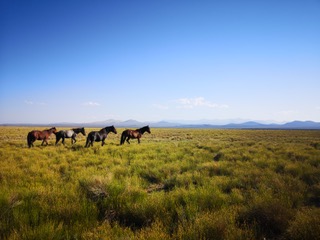
Image by Yancen Diemberger
Yancen Diemberger, PhD candidate, University of Exeter
De Nuevo Estoy de Vuelta [1]
My reconnaissance trip to Argentina is drawing to a close, and there is much on which to reflect…
The curiosity that shaped my research question, “How do horses and humans communicate in the Himalayas and Argentina”, was born while I lived in Argentina and before I had any idea of its future academic evolution. During the pandemic I was stuck in the UK, and my personal interest shaped itself into the idea for this PhD thesis. Many research related documents require certainty in the plans you present. In current times, plans need flexibility to accommodate the unexpected. These two elements lie in tension.
This is the first time I have been back to Argentina since the pandemic and since the development of my PhD thesis on the construction of horse-human communication. During this trip, imagination and theory finally met reality.
While in the UK, I had to shape and present my PhD project around memory and relations that lay halfway across the globe in an area with little network coverage and communicative ability. Since my last visit many things have changed and, just as I’d thought, this trip was necessary to understand the new situation on the ground.
I arrived in Buenos Aires with a handful of contacts mainly comprising of academics and horse tamers. I had a vague plan with rough time slots that included going to the interior [2] (where I had been living previously) to re-connect with the two- and four-legged friends who live there. The uncertainty of what was to come, however, had inhibited me in planning much ahead. From this came a daunting feeling of being unprepared, which made me feel inadequate and gave me a constant impostor’s syndrome with regards to both the academic and the practical horse-related world. I felt as though I was trying to do both whilst being good at neither. The fluidity of my plans, however, soon turned out to be a blessing in disguise and pieces started to appear and fall into place.
One contact led to another, one conversation shaped my approach to the next, and to my surprise and relief, people were not only helpful but also extremely interested in my project. During these past two months I have lived and breathed the project non-stop. There has been no weekend or hours of “disconnect” because even the most unexpected moments, people, and situations have led to the creation of connections, opening of doors, and birth of ideas.
I remember wanting to dance tango at the public square on a Sunday night (common in several neighbourhoods of Buenos Aires). My Argentine “adoptive mum” and her friend took me to the local plaza [3], watching and laughing as I attempted to tango my way around a square filled with talented 60+ year old bailarines [4]. When my dance partners had had enough of me stepping on their toes, I decided to join in with the chats. Friends and family had arrived, and though no one was a “horse-person” themselves they all wanted to help, giving me advice and contacts, including that of a renowned “encantador de caballos” [5] from a nearby city which is renowned for the preservation of Gaucho culture and history. This link that came out of the blue culminated in one of many meetings that have resulted in an amazing discussion, a day of intense horse-human relations, and a longer-term collaboration.
I wanted to dedicate part of my time in Argentina to working in the field (rather work of the fields than fieldwork). I knew I would need some time to digest all of the Buenos Aires experience, and my friend suggested we work on a farm, herding cattle, horses, fixing fences, and “taming” two stallions. This experience was fundamental both with regard to my multi-species relations, as well as my fieldwork site. Working with cattle put me in direct contact with Petitt and Brandt-Off’s (2022) idea of a “trialogue” between horses, cows and humans. This gave me food for thought on how relations change both within and across the species when there is a common goal and understanding. My relations with Oscuro and Piccolo, the young stallions we were starting, also played an important role in this trip. Not only did it reinforce my critical engagement with the ethics of my own position and actions, but it also allowed me to put into practice my tentative methodological plan that so far had only been theory. In this, my communication across the species and my own construction of a communicative framework between horse and human (both of which are central themes to my PhD thesis) were directly scrutinized. In the place we stayed, there were four other guys apart from me and Olive (my friend from the UK). Two were brothers who mainly worked with the cattle, one of whom was dedicated to the campo [6] in heart and soul, while the other saw it as a form of temporary employment and dedicated the rest of his time to being a locally renowned character/influencer on social media. Another member of the team was focused on construction, and finally there was the boss and owner of the land/natural reserve. We were also in the company of two cats (mother and daughter with a very affectionate relationship) and five dogs, each with their own complicated background (some had come to the farm from abusive households, others had simply appeared on the land in terrible health conditions after wandering the enormous flatlands under the relentless sun). These conditions allowed me to extend my observations of human-animal relations beyond the horses, and to try understanding the context within which interactions occur from different human and other-than-human perspectives and histories.
“Acceptance” has been a key word during this trip. Though suiting to my current situation, it wasn’t me that brought it up, but rather one of the people I used to live with. We spent hours talking about acceptance, and it kept cropping up in my interactions with other humans and non-humans alike. Accepting limitations, changes, surprises… things… is often hard. Many people react against what they don’t want to accept, or perhaps see acceptance as a defeat. This trip has shown me that “accepting” generates a space for new permutations and possibilities to arise. These can lead out of, around, and to, new situations in the most unexpected of ways. Upon reflection, during this trip and generally in life, my main problems arose when I wasn’t willing to accept. Acceptance allows you to take a firm step into insecurity, from which one can carry on jumping straight into the adventure.
I am currently accepting the fact that I caught Covid on the way to visiting a kind sociology Professor at the University of Curitiba, Brazil. We had been planning my visit for some time, and we had a very tight agenda which must now be totally rethought. Despite changing our plans, this finally gives me the opportunity to take a minute and process the past couple of months. During this trip, I have tested statements which until now were merely words full of hope “I have family-like connections on site who will help me with the logistics…”, “I will work with human and horse interlocutors whom I know and trust…”. It has been moving to see how my relations on site have stood the test of time and the pandemic. It is exciting to see how this network is adapting to the current circumstances and in fact expanding. It is a relief to feel that there is a team who will help me take on the adventures of what is to come.
[1] Transl. I’m back again. First line of the song “Luna Cautiva” a well-known piece in Argentine folk music.
[2] Term used to differentiate between the capital Buenos Aires and the rest of Argentina.
[3] Transl. Public square. In Argentina these are often designed and constructed with musicians and dancers in mind, therefore, it may include a permanent stage and sitting area that surrounds a dancefloor.
[4] Transl. Dancers.
[5] Transl. Horse charmer. Expression borrowed from and adapted from the more notorious “snake charmer”.
[6] Transl. Field. This term does not only imply to an area of open land but also everything related to countryside both practically and symbolically.
Author Bio:
I am a PhD student at the University of Exeter studying horse-human communication in different cultural contexts under the supervision of Samantha Hurn. I was born to Tibetan/Italo-Austrian parents and brought up in the UK where I began working with horses as a teenager. I completed a Bachelors in Tibetan and South Asian Studies at Vienna University (AU) and worked in different NGO projects in the Himalayas. One of these projects brought me back to horses, and I started moving around Latin America working in different horse-related contexts. Throughout my life I have been constantly switching between languages, cultures, and environments, and I find communication within and across the species vital to coexistence on this planet.
References:
Petitt, A., & Brandt-Off, K. (2022). Zoocialization: Learning Together, Becoming Together in a Multispecies Triad, Society & Animals (published online ahead of print). doi: https://doi.org/10.1163/15685306-bja10082.
 Anthrozoology as Symbiotic Ethics