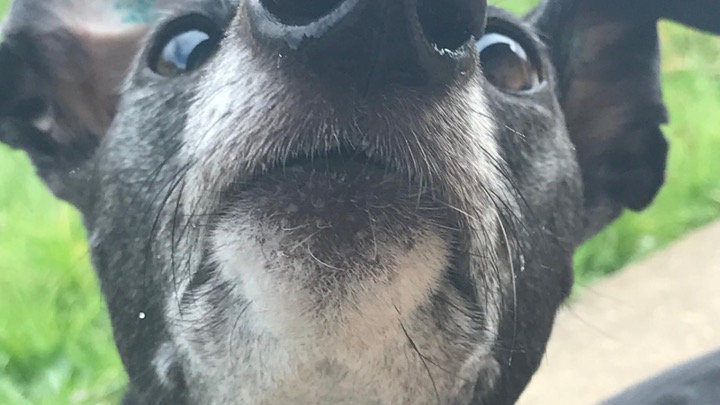
Image by Kerry Herbert
Kerry Herbert, Anthrozoology PhD candidate, University of Exeter
As a PhD student who is part of the EASE working group, my research is underpinned by the reframing of Anthrozoology as symbiotic ethics.
This means that I conceive of and attend to the participants in my research as subjective, heterogenous and intrinsically valued beings. However, this ideological position presents some methodological challenges. The non-human others whose lives I am exploring dwell within animal-use industries, where considerations of non-human agency and volition grate against the normative flow of knowledge-production. My research focuses on exploring the lives and experiences of a presumed-homogenous population of dogs whom, for the past c100 years, have been instrumentalised in the name of human entertainment. Fusing together academic pursuit and frontline advocacy which involves caring for injured and unwanted race dogs, my work interrogates and problematises the commodification of greyhounds.
The greyhounds who feature in my doctoral research are situated as my friends, family members and canine informants. As a scholar activist (Lopez and Gillespie, 2019: 7), I am ethically invested in examining the systemic oppression and power differentials which underpin anthropocentric representations of non-human others, seeking to address what Groling has described as ‘the paucity of research on the powerful’ (2014: 90). And by striving to know greyhounds who live inside these systems through the cultivation of empathic and emotional knowledge (Hurn, 2018; Gruen, 2015), I am committed to creating a politically engaged knowledge-project, which can inform social change efforts for this vulnerable population of dogs.
Being engaged in such ethnographic “dirty” interspecies work (Wilkie, 2015: 212) has taken me to viscerally confronting places. From the back regions (Goffman, 1959) of commercial racing, to the dirty emotional work (Sanders, 2010) of the emergency vet room, where battles to save the lives and limbs of injured greyhounds are won and lost. Perhaps unsurprisingly, navigating these experiences has left an emotional residue, which I continue to process through advocacy and writing. Yet they have also enabled me to attend to the sharp corners in my research, which through the nuance of subjective experience puncture the homogeny of systemic exploitation.
Reflecting on my journal entry after one particularly grueling week of advocacy, perhaps illustrates some of these troubling angles in my research:
As I gaze at Jacob [my latest foster boy with a newly-repaired fractured leg] I wonder how this all stacks up for him. He rests amid the unfamiliarity of my kitchen. Seemingly passively, quietly, compliantly. Oh, maybe it’s the tramadol? I hate the way it seems to slough them of their agency, removing the questions from their eyes. Because there must be questions. There are always questions. Maybe I’ll begin to see them in the morning; that familiar messy mix of curiosity and apprehension that I’ve witnessed so often as they crash-land here after their ordeal. But what do I say in response? “It’s OK; we’ve saved your life” or maybe “I’m sorry, we’ve taken your life away”. I’m not sure which brings the most comfort for me or for Jacob.
Inspired by the immersive ethnographies of scholars whose work has critically yet reflexively examined the inner workings of animal-use industries (Pachirat, 2011; Gillespie, 2018; Guenther, 2020), I strive to conduct my own research on the complexities of the greyhound racing and rescue industries with sensitivity and discernment. As a greyhound rescuer, and subsequent welfare-industry critical insider (Hodkinson, 2002: 6), I use my positionality in this social space to disrupt and contest the anthropocentricities inside Madden’s conception of ‘the [total] greyhound imaginary’ (Madden, 2010: 504). I believe that such limited ways of thinking about these dogs have contributed to the creation of an abstract or mythical greyhound (Bekoff, 2018; Groziard, 2019), as an archetypal gentle, easy-going and well-mannered pet (Rice, 2018; Greyhound Trust, 2021). Paradoxically, such homogeny moves us further away from finding out who greyhounds really are; whilst also dangerously disconnecting us from the realities of how they are exploited. In response to this, my applied anthrozoological endeavour calls for the assimilation of more greyhound-centric knowledge, including the utilisation of trauma-informed approaches to caring for those damaged individuals who are rescued from the racing industry.
Author Bio:
Kerry is an Anthrozoologist, PhD student at the University of Exeter and ethical vegan whose work sits within the context of scholarly activism. Her advocacy predominantly focuses on helping former racing greyhounds to navigate new lives as companions and creating new narratives of care for these traumatised individuals. Kerry’s scholarly work calls for social change for greyhounds and is informed by her frontline experiences of living with, caring about and advocating for this vulnerable population of domestic dogs.
Contact email: Klh230@exeter.ac.uk
References:
Bekoff, M. (2018). Canine Confidential. US: University of Chicago Press.
Gillespie, K. (2019). The Cow With Ear Tag #1389. Chicago and London: The University of Chicago Press.
Goffman, E. (1959). The Presentation of Self in Everyday Life. Garden City, NY: Doubleday-Anchor.
Groling, J. (2014). Studying perpetrators of socially- sanctioned violence against animals through the I/eye of the CAS scholar in Taylor, N. and Twine, R. Eds The Rise of Critical Animal Studies. London and New York: Routledge.
Groizard, J. (2019). Greyhounds and Racing Industry Participants: A Look at the New South Wales Greyhound Racing Community, Animal Studies Journal, 8(1), pp.133 – 157.
Greyhound Trust (2021) About Us. Available from: https://www.greyhoundtrust.org.uk/about-us Accessed: 20 February 2021
Gruen, L. (2015). Entangled Empathy; An alternative ethic for our relationships with animals. New York: Lantern Books
Guenther, K.M. (2020). The Lives and Deaths of Shelter Animals. Stanford University Press: California.
Hodkinson, P. (2002). Goth: Identity, Style and Subculture. Bloomsbury Publishing: London.
Hurn, S. (2018). Encounters with Dogs as an Exercise in Analysing Multi-Species Ethnography, in Lewis, J. (ed). SAGE Research Methods Dataset. SAGE: London.
Lopez, P. J., and Gillespie, K. (2019). Introduction, in Gillespie, K. and Lopez, P.J. Eds. Vulnerable Witness: The Politics of Grief in the Field. University of California Press: Oakland, California.
Madden, R. (2010). Imagining the greyhound: ‘Racing’ and ‘rescue’ narratives in a human and dog relationship. Continuum: Journal of Media and Cultural Studies, 24(4), pp.503–515.
Pachirat, T. (2011). Every Twelve Seconds. Industrialised Slaughter and the Politics of Sight. Yale University Press.
Rice, S. (2018) Educational Experiences in Prison: Greyhounds and Humans Teaching and Learning Together. In: Rice S., Rud A.G (Eds) The Educational Significance of Human and Non-Human Interactions. Palgrave Macmillan: New York.
Sanders, C. R. (2010). Working Out Back: The Veterinary Technician and “Dirty Work”. Journal of Contemporary Ethnography, 39(3), pp.243-272.
Wilkie, R. (2015). Academic Dirty Work. Society and Animals, 23(3), pp 211-230.
 Anthrozoology as Symbiotic Ethics
One thought on “Symbiotic ethics and valuing greyhound lives”