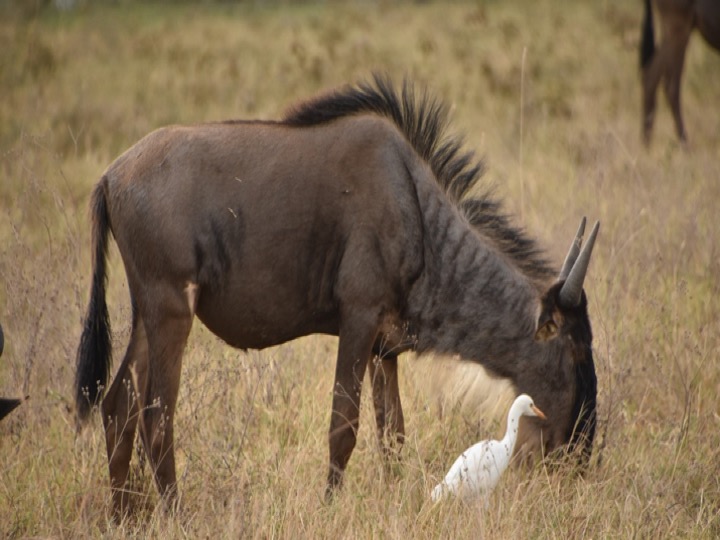
Wildebeest grazing in Serengeti National Park, Tanzania. Image by Robin Fiore
Robin Fiore, Anthrozoology PhD candidate, University of Exeter
One researcher, one culture, one year. That is the traditional ideal for good ethnography (Randall et al., 2007). But how do you spend time in another culture when you can’t even leave your living room? When the COVID-19 pandemic struck I was preparing to travel to Kenya. Not for a year and not to write the traditional ethnography, but to conduct research for the new type of ethnography, a multispecies ethnography of a conservation encounter (Kiik, 2018; Moore, 2017). My research focuses on the ways that malignant catarrhal fever (a disease of wildebeest) affects Maasai livelihoods and conservation efforts. My time in Kenya would have revolved around interviewing local Maasai herders about their experiences with the disease and observing wildebeest (Connochaetes taurinus) to determine if Maasai persecution of them is changing their behavior, as is the case with other animals in human areas (Kioko et al., 2015; Ogutu et al., 2005; Schuette et al., 2013). However, when travel became impossible the staple methodologies behind my research also became impossible. In fact, the staple methodology, fieldwork, behind all anthropological research became impossible. So, what should we do? Should we sit in our ivory tower twiddling our thumbs and wait for the pandemic to pass? Should we then resume business as usual? What happens when the next pandemic strikes, as it certainly will?
I decided not to wait, but to radically alter all aspects of my methodology and try to create an analysis of a conservation encounter entirely from behind a computer. The first problem was how to access the Maasai from half a world away. My first idea was to hire local people in Kenya to travel to Maasai villages and talk to them on my behalf, but that idea was also unfeasible due to the possibility they could bring COVID from the urban areas of Kenya to rural populations. This methodology also had a real possibility of introducing uncontrolled bias. I was left with just one option: the internet. My new methodology involves creating an online survey, distributed through social media and a network of gatekeepers. I had recently had unexpected success in accessing opinions on a sensitive topic through this methodology and I had started to wonder whether impersonal methods might actually garner more honest and open responses. I first contacted companies that conduct online research. They all told me the Maasai would be an impossible population to reach. I have not found any academic attempts to engage with the Maasai in this way. And yet, once I started looking, I found a wonderful and thriving corner of social media dedicated to this community. They post, they like, they share. They discuss places to herd their cattle and they sell their beadwork in groups online. If I can gain access to this corner of social media, I can engage with this group in a novel way and perhaps learn things about them I could not have learned in person. My experiences with the Maasai have revealed an extremely polite society that views all outsiders as guests and believes insulting them is the ultimate misconduct. Face-to-face research with them always comes with the possibility of only learning what they feel is polite to tell you. Alternatively, the Maasai are not as practiced as other cultures in how to take online surveys, so they may get bogged down in the procedures rather then easily responding to the questions. Then of course, there are brand new ethical considerations to work through. I have ended up with entirely online methods partly due to working with a group traditionally recognized as vulnerable. But how does working online reclass who is vulnerable? Do online methods give the Maasai more or less power? These ethical considerations will need to be explored as we increasingly work online with different groups (Luh Sin, 2015).
But what about the wildebeest? The point of the multispecies ethnography is to give the animals a voice, to represent them as agents in encounters with humans (Moore, 2017). Wildebeest are one group I cannot access through the internet. Or can I? Snapshot Safari is a project that uses a huge network of camera traps to capture images of animals all over East Africa (Swanson et al., 2015). This project produces millions of still images, far more than any research team could analyze. The images are then crowdsourced out to citizen scientists, who determine what animals are pictured and the behaviors demonstrated (Swanson et al., 2015). By using two sites in the Snapshot Safari network, one in a Maasai area and one outside of Maasai areas, I hope to determine if Maasai activities are changing wildebeest behaviors such as levels of vigilance. The enormous data sets generated by the Snapshot Safari project (and many other projects like it) are out there waiting to be analyzed and used. It took a simple email to a very enthusiastic scientist to request the data and get started analyzing a data set larger than any I could possibly have collected myself.
The novel methodologies I have found have given me hope, not just for my research, but for my disciplinary field. Because this is not the last pandemic. As humans spread and encroach further into animal habitats, we invite novel pathogens to jump the species barrier and become global infections (Gill, 2020). With COVID-19 shutdowns lasting months and years, not weeks, and more pathogens on the way, anthrozoology, anthropology, and its related disciplines must find a way to stay relevant and continue to produce meaningful work. Now more than ever the interactions between humans and other animals are of critical importance to the world. We cannot get caught up in traditional ideals of what our methodology should be. We can find new ways of engaging with cultures, animals, and data. What started for me as a hopeless crumbling of my carefully constructed methodology has turned into a hopeful restructuring of what anthrozoology can be. This is not the last pandemic. But that does not have to stop the production of meaningful work.
Author Bio:
Robin Fiore is an Anthrozoology PhD student with the University of Exeter and a member of the Exeter Anthrozoology as Symbiotic Ethics Working Group. Her research focuses on human-wildlife conflict between Kenyan Maasai and wildebeest over malignant catarrhal fever passed from wildebeest to cattle. Robin is interested in how existing cultural systems can be harnessed to help solve the issues of human-wildlife conflict. She is also the Assistant Curator of Education at the Brandywine Zoo in Wilmington, Delaware where she enjoys connecting people of all ages with animals and conservation.
Contact Email: rf408@exeter.ac.uk
References:
Gill, V. (2020). Coronavirus: This is not the last pandemic. [online] BBC News. Available at: <https://www.bbc.com/news/science-environment-52775386> [Accessed 14 February 2021].
Kiik, L. (2018) ‘Wild-ing the Ethnography of Conservation: Writing Nature’s Value and Agency In’, Anthropological Forum, 28(3), pp. 217–235.
Kioko, J., Kiffner, C., Ndibalema, V., Hartnett, E., and Seefeld, C. (2015) Maasai people and elephants: values and perceptions Human-animal interactions form a central part of many society’s existence, Indian Journal of Traditional Knowledge, 1(1), pp.13–19.
Luh Sin, H. (2015). “You’re Not Doing Work, You’re on Facebook!”: Ethics of Encountering the Field Through Social Media. The Professional Geographer, 67(4), pp.676-685.
Moore, L. (2017). Catch and release. New York: New York University Press.
Ogutu, J.O., Bhola, N. and Reid, R. (2005) The effects of pastoralism and protection on the density and distribution of carnivores and their prey in the Mara ecosystem of Kenya, Journal of Zoology, 265(3), pp. 281–293.
Randall, D., Harper, R. and Rouncefield, M. (2007). Fieldwork for design. London: Springer.
Schuette, P., Creel, S. and Christianson, D. (2013) Coexistence of African lions, livestock, and people in a landscape with variable human land use and seasonal movements, Biological Conservation. Elsevier Ltd, 157, pp. 148–154.
Swanson, A., Kosmala, M., Lintott, C., Simpson, R., Smith, A. and Packer, C. (2015). Snapshot Serengeti, high-frequency annotated camera trap images of 40 mammalian species in an African savanna. Scientific Data, 2(1).
 Anthrozoology as Symbiotic Ethics